In balance between technology and psychology, Elisa’s story
Technical Consultant, one year at Mashfrog and two passions: IT and psychology. Elisa shares her professional journey that led her to join Mashfrog and work fully remote.

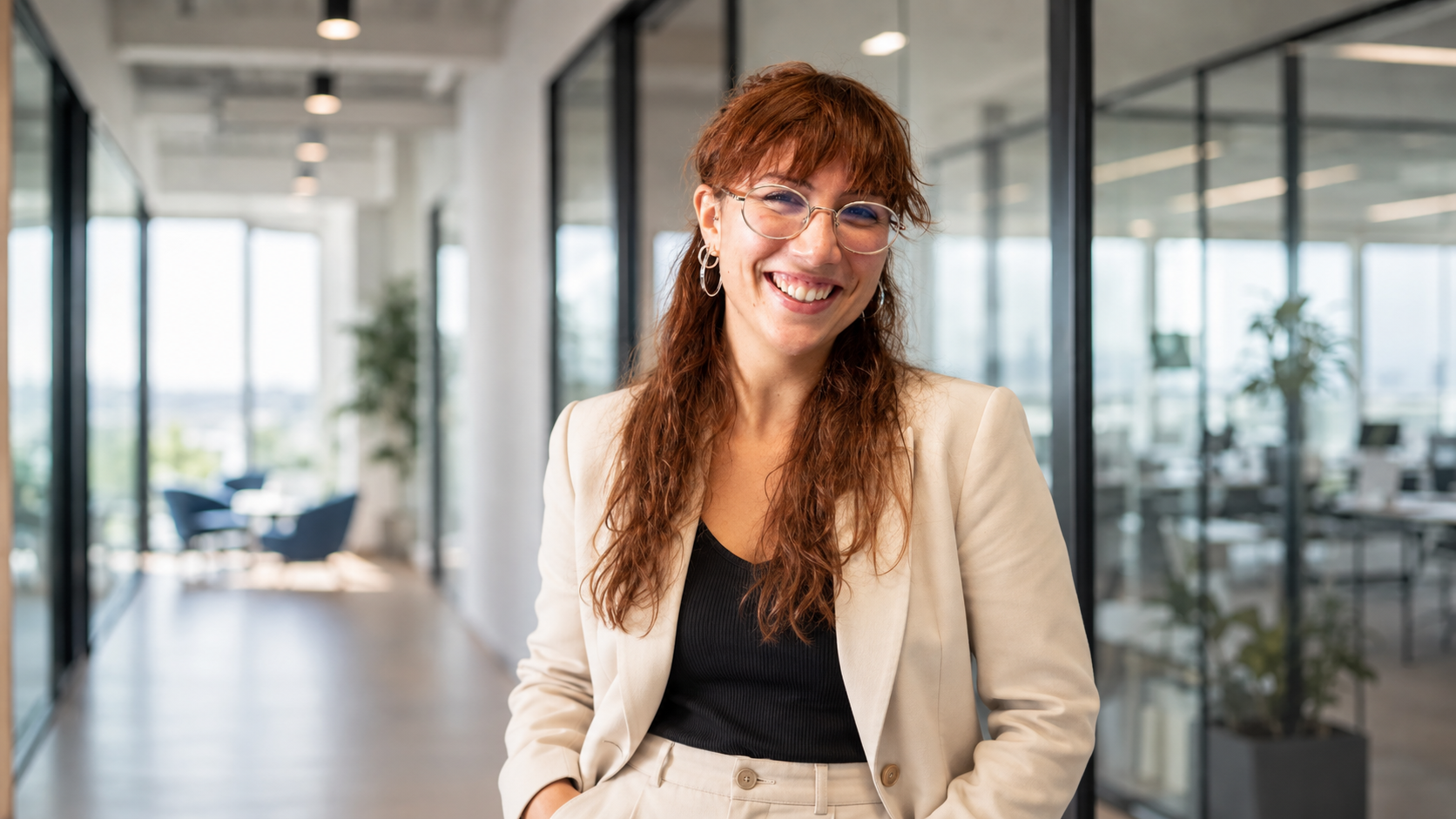
Young, driven, and fueled by a dual passion that bridges technology and the humanities, Elisa Mangano is a Technical Consultant in Mashfrog’s Customer & Marketing Practice. She joined the company in February 2025 and works fully remote from Messina, the city where she was born and raised. Her path has been anything but linear—shaped by thoughtful choices, pauses, and fresh starts—guided by a constant desire to combine technical expertise and personal sensitivity.
Elisa, what has your first year at the company been like?
It’s been an intense and highly educational year. I’ve worked on several projects, focusing on Salesforce development—both on the coding side, including front-end and back-end, and on platform configuration activities.
Initially, I joined as a support resource on a project for a major energy utility, and it was a key step in getting familiar with tools, processes, and team dynamics. Over time, I began taking on a more hands-on role. On the Infor project—my first long-term assignment—I truly felt like an integral part of the team. I followed the different phases all the way through go-live and gradually took on increasingly complex tasks. This allowed me to grow significantly, not only from a technical standpoint, but also in the way I collaborate with others and tackle challenges.
How did your passion for IT begin?
I attended a technical high school specializing in computer science—a choice I strongly pursued despite my parents’ skepticism. It was a predominantly male environment, but I never saw it as a limitation. On the contrary, it helped me grow and further strengthen my passion for programming.
My high school years were intense and inspiring. Verona Trento Technical Institute gave me the opportunity to take part in national and international competitions and to frequently work in teams on real-world projects. At the national level, I participated in two editions of the Nao Challenge: the first focused on applying robotics to themes of inclusion and diversity, and the second explored the connection between art and robotics. In Italy, I also took part in the Robotics Championships and the Italian team Programming Olympiad. Internationally, I participated in AstroPi—my very first programming experience centered on a Raspberry Pi computer placed aboard a space station—and in Zero Robotics, a highly complex math and programming challenge focused on satellite trajectories in space. It was during that time that I realized how much I loved coding and turning an idea into something functional and tangible.
After graduating, you chose to enroll in Psychology. What led you to that decision?
After high school, I felt the need to pause and reflect. I had devoted myself to computer science with great enthusiasm, but deep down I also felt a desire to explore another dimension—one more connected to understanding people. So I enrolled in Psychology and, for a while, set programming aside.
It was an important phase because it helped me realize that I didn’t want to leave the tech world behind, but rather find a balance between my two passions. I enrolled in a professional Salesforce course that included job placement, and that’s how my career path began. Today, I continue to study Psychology, and I feel that the two disciplines complement each other. Computer science is practical, concrete, and solution-oriented; psychology helps me better understand relationship dynamics and what lies behind people’s behaviors.
How do you manage to balance work and university?
It’s a challenge, but also a great opportunity. Working fully remote allows me to organize my time more effectively and find a balance between studying and working. From this perspective, I feel supported at Mashfrog, and that truly makes a difference. There’s real attention to individual needs and a collaborative environment that makes everything more sustainable. Of course, it requires organization and consistency, but knowing you can rely on a positive and supportive workplace helps you approach each day with greater peace of mind.
Do you enjoy working fully remote?
I’ve been working remotely since the very beginning of my career, so for me it’s the norm. On one hand, it has been a great opportunity because it allowed me to enter the workforce right away, even while living in an area where Salesforce opportunities may be more limited compared to other regions. The main advantage is balance. I can live in my hometown, close to my family and loved ones, and at the same time work on international projects that are very valuable. For me, since I’m still studying, this flexibility is essential. On the other hand, I sometimes miss direct contact with my colleagues. I’ve never fully experienced office life, and sooner or later I’d like to try it. That’s why I’m planning a trip to Milan to meet in person the people I collaborate with every day. I believe that seeing each other face to face can further strengthen our relationships.
How connected do you feel to your hometown? Do you see yourself elsewhere in the future?
I was born and raised in Messina, and today I feel very connected to my city. In the past, I wanted to leave—perhaps because I felt the need to carve out my own space. Over time, I’ve learned to better appreciate what I have here: the area itself, the people I care about, and the opportunity to live in close contact with the sea and nature.
I don’t rule out having experiences in other cities or regions—I enjoy traveling, exploring, and discovering new places—but my dream would be to always come back here, home. Having the freedom to choose—that, to me, is essential.
What do you do in your free time?
In my free time, I mainly try to connect with nature. I love walking and I’ve been getting more and more into trekking, with the goal of taking on longer routes in the future. About a year ago, I also started running. I don’t approach it competitively, but rather as a personal moment to disconnect, clear my mind, and regain focus. And then there’s traveling, which is a constant opportunity for discovery and growth—a way to open myself up to new cultures and perspectives.
Looking ahead, where do you see yourself in ten years?
It’s a question that always makes me hesitate a bit, because I’m someone who changes and evolves. Today, I still see myself working in IT, perhaps with deeper expertise and a greater awareness of my role.
At the same time, I’d like to find a way to integrate IT and psychology. I don’t see myself following a traditional path as a psychologist, but rather doing something more creative, where technology and an understanding of human behavior can interact. Maybe in fields like artificial intelligence, or in contexts where the technical component works hand in hand with the human one. It’s still an open path, but I like to think of it as a gradual process, built through experience, study, and new challenges.